
This is the thirty-fourth in a series of Covington blogs on implementation of Executive Order 14028, “Improving the Nation’s Cybersecurity,” issued by President Biden on May 12, 2021 (the “Cyber EO”).  The first blog summarized the Cyber EO’s key provisions and timelines, and the subsequent blogs describes described the actions taken by various government agencies to implement the Cyber EO from June 2021through January 2024.  This blog describes key actions taken to implement the Cyber EO, as well as the U.S. National Cybersecurity Strategy, during February 2024.  It also describes key actions taken during February 2024 to implement President Biden’s Executive Order on Artificial Intelligence (the “AI EO”), particularly its provisions that impact cybersecurity, secure software, and federal government contractors. 

NIST Publishes Cybersecurity Framework 2.0

            On February 26, 2024, the U.S. National Institute of Standards and Technology (“NIST”) published version 2.0 of its Cybersecurity Framework.  The NIST Cybersecurity Framework (“CSF” or “Framework”) provides a taxonomy of high-level cybersecurity outcomes that can be used by any organization, regardless of its size, sector, or relative maturity, to better understand, assess, prioritize, and communicate its cybersecurity efforts.  CSF 2.0 makes some significant changes to the Framework, particularly in the areas of Governance and Cybersecurity Supply Chain Risk Management (“C-SCRM”).  Covington’s Privacy and Cybersecurity group has posted a blog that discusses CSF 2.0 and those changes in greater detail.

NTIA Requests Comment Regarding “Open Weight”

Dual-Use Foundation AI Models

            Also on February 26, the National Telecommunications and Information Administration (“NTIA”) published a request for comments on the risks, benefits, and possible regulation of “dual-use foundation models for which the model weights are widely available.”  Among other questions raised by NTIA in the document are whether the availability of public model weights could pose risks to infrastructure or the defense sector.  NTIA is seeking comments in order to prepare a report that the AI EO requires by July 26, 2024 on the risks and benefits of private companies making the weights of their foundational AI models publicly available.  NTIA’s request for comments notes that “openness” or “wide availability” are terms without clear definition, and that “more information [is] needed to detail the relationship between openness and the wide availability of both model weights and open foundation models more generally.”  NTIA also requests comments on potential regulatory regimes for dual-use foundation models with widely available model weights, as well as the kinds of regulatory structures “that could deal with not only the large scale of these foundation models, but also the declining level of computing resources needed to fine-tune and retrain them.”Continue Reading February 2024 Developments Under President Biden’s Cybersecurity Executive Order, National Cybersecurity Strategy, and AI Executive Order
In early March 2024, the EU lawmakers reached agreement on the European Health Data Space (EHDS).  For now, we only have a work-in-progress draft version of the text, but a number of interesting points can already be highlighted.  This article focusses on the obligations of data holders; for an overview of the EHDS generally, see our first post in this series.

We expect the final text of the EHDS to be adopted by the European Parliament in April 2024 and by the EU Member States shortly thereafter.

1: Health data holder

The term “health data holder” includes, among others, any natural or legal person developing products or services intended for health, developing or manufacturing wellness applications, or performing research in relation to healthcare, who:

  • in relation to personal electronic health data: in its capacity of a data controller has the right or obligation to process the health data, including for research and innovation purposes; or
  • in relation to non-personal electronic health data: has the ability to make the data available through control of the technical design of a product and related services.  These terms appear to be taken from the Data Act, but they are not defined under the EHDS.

In practice, this means that, for example, hospitals, as data controllers, are data holders of their electronic health records.  Similarly, pharmaceutical companies are data holders of clinical trial data and biobanks.  Medical device companies may be data holders of non-personal data generated by their devices, if they have access to that data and an ability to produce it.  However, medical device companies would not qualify as a data holder where they merely process personal electronic health data on behalf of a hospital.

Individual researchers and micro enterprises are not data holders, unless EU Member States decide differently for their territory.

2: Data sets covered by EHDS

The EHDS sets out a long list of covered electronic health data that should be made available for secondary use under the EHDS.  It includes, among others:

  • electronic health records;
  • human genetic data;
  • biobanks;
  • data from wellness applications;
  • clinical trial data – though according to the recitals, this only applies when the trial has ended;
  • medical device data;
  • data from registries; and
  • data from research cohorts and surveys, after the first publication of the results – a qualifier that does not seem to apply for clinical trial data.

Continue Reading EHDS Series – 2: The European Health Data Space from the Health Data Holder’s Perspective

On March 28, the White House Office of Management and Budget (OMB) released guidance on governance and risk management for federal agency use of artificial intelligence (AI).  The guidance was issued in furtherance of last fall’s White House AI Executive Order, which established goals to promote the safe, secure, and

Continue Reading OMB Issues First Governmentwide AI Policy for Federal Agencies

On Monday, March 25, Florida Governor Ron DeSantis signed SB 3 into law. At a high level, the bill requires social media platforms to terminate the accounts of individuals under the age of 14, while seeking parental consent for accounts of those 14 or 15 years of age. The law

Continue Reading Florida Enacts Social Media Bill Restricting Access for Teens Under the Age of Sixteen

On March 27, 2024, the U.S. Cybersecurity and Infrastructure Security Agency’s (“CISA”) Notice of Proposed Rulemaking (“Proposed Rule”) related to the Cyber Incident Reporting for Critical Infrastructure Act of 2022 (“CIRCIA”) was released on the Federal Register website.  The Proposed Rule, which will be formally published in the Federal Register on April 4, 2024, proposes draft regulations to implement the incident reporting requirements for critical infrastructure entities from CIRCIA, which President Biden signed into law in March 2022.  CIRCIA established two cyber incident reporting requirements for covered critical infrastructure entities: a 24-hour requirement to report ransomware payments and a 72-hour requirement to report covered cyber incidents to CISA.  While the overarching requirements and structure of the reporting process were established under the law, CIRCIA also directed CISA to issue the Proposed Rule within 24 months of the law’s enactment to provide further detail on the scope and implementation of these requirements.  Under CIRCIA, the final rule must be published by September 2025.

The Proposed Rule addresses various elements of CIRCIA, which will be covered in a forthcoming Client Alert.  This blog post focuses primarily on the proposed definitions of two pivotal terms that were left to further rulemaking under CIRCIA (Covered Entity and Covered Cyber Incident), which illustrate the broad scope of CIRCIA’s reporting requirements, as well as certain proposed exceptions to the reporting requirements.  The Proposed Rule will be subject to a review and comment period for 60 days after publication in the Federal Register. 

Covered Entities

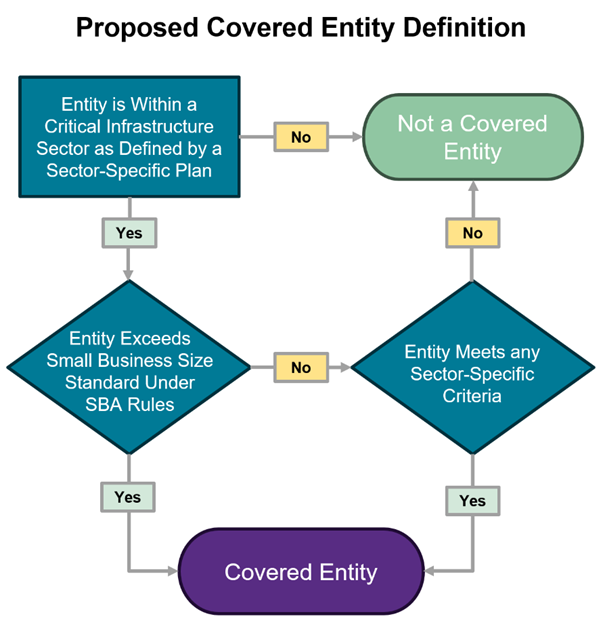
CIRCIA broadly defined “Covered Entity” to include entities that are in one of the 16 critical infrastructure sectors established under Presidential Policy Directive 21 (“PPD-21”) and directed CISA to develop a more comprehensive definition in subsequent rulemaking.  Accordingly, the Proposed Rule (1) addresses how to determine whether an entity is “in” one of the 16 sectors and (2) proposed two additional criteria for the Covered Entity definition, either of which must be met in order for an entity to be covered.  Notably, the Proposed Rule’s definition of Covered Entity would encompass the entire corporate entity, even if only a constituent part of its business or operations meets the criteria.  Thus, Covered Cyber Incidents experienced by a Covered Entity would be reportable regardless of which part of the organization suffered the impact.  In total, CISA estimates that over 300,000 entities would be covered by the Proposed Rule.

Decision tree that demonstrates the overarching elements of the Covered Entity definition. For illustrative purposes only.Continue Reading CISA Issues Notice of Proposed Rulemaking for Critical Infrastructure Cybersecurity Incident Reporting

In early March, the EU released its first-ever European Defence Industrial Strategy (EDIS), accompanied by a proposed regulation establishing the European Defence Industry Programme (EDIP). The aim is to boost defence capabilities in Europe through greater and more efficient spending. In particular, the strategy seeks to reverse recent trends, whereby 78% of defence acquisitions by EU countries since Russia’s full-scale aggression against Ukraine were made with non-EU producers, with U.S. firms accounting for 63%. It also addresses recent concerns by the defence industry over ESG constraints on obtaining private financing.

The ultimate benchmark for success, as recounted by one EU foreign minister, is whether these measures will help deter Russia and other adversaries. Nonetheless, it reflects greater operational focus of the EU on defence and security issues, and what in practice the European Commission and other EU institutions can do to bolster capabilities in a policy area that will remain the primary prerogative of EU Member States.

Plugging Defence Gaps

Since the end of the Cold War, European defence has suffered from perennial underinvestment and lack of policy support for the defence industry. Whereas Europe collectively spent on defence over half of the U.S. totals in the early 1990s, it now spends about one-third compared to the United States—arguably at a time of much greater security threats to Europe compared to America. There are simply not enough soldiers, tanks, planes, ships, missiles, guns, and ammunition in Europe, nor domestic facilities to produce the necessary weapons systems and materiel. Moreover, EU countries have procured defence products at a national level, exacerbating fragmentation within the European market. This fragmentation has led to the creation of national industrial silos and numerous defence systems that often lack interoperability.Continue Reading Mobilizing Greater Defence Capabilities in Europe: the EU’s Defence Industrial Strategy

Earlier this week, Members of the European Parliament (MEPs) cast their votes in favor of the much-anticipated AI Act. With 523 votes in favor, 46 votes against, and 49 abstentions, the vote is a culmination of an effort that began in April 2021, when the EU Commission first published its 

Continue Reading EU Parliament Adopts AI Act

On 20 February, 2024, the Governments of the UK and Australia co-signed the UK-Australia Online Safety and Security Memorandum of Understanding (“MoU”). The MoU seeks to serve as a framework for the two countries to jointly deliver concrete and coordinated online safety and security policy initiatives and outcomes to support their citizens, businesses and economies.

The MoU comes shortly after the UK Information Commissioner’s Office (“ICO”) introduced its guidance on content moderation and data protection (see our previous blog here) to complement the UK’s Online Safety Act 2023, and the commencement of the Australian online safety codes, which complement the Australian Online Safety Act 2021.

The scope of the MoU is broad, covering a range of policy areas, including: harmful online behaviour; age assurance; safety by design; online platforms; child safety; technology-facilitated gender-based violence; safety technology; online media and digital literacy; user privacy and freedom of expression; online child sexual exploitation and abuse; terrorist and violent extremist content; lawful access to data; encryption; misinformation and disinformation; and the impact of new, emerging and rapidly evolving technologies such as artificial intelligence (“AI”).Continue Reading UK and Australia Agree Enhanced Cross-Border Cooperation in Online Safety and Security

On February 28, the European Data Protection Board (“EDPB”) announced that EU supervisory authorities (“SAs”) will undertake a coordinated enforcement action in 2024 regarding data subjects’ right of access under the GDPR.  For context, the EDPB selects a particular topic each year to serve as the focus for pan-EU coordinated

Continue Reading EDPB’s 2024 Coordinated Enforcement Action on the Access Right: What Can You Expect?

This year’s Munich Security Conference reemphasized the need for Europe to invest in greater defense capabilities and foster a regulatory environment that is conducive to building a defense and technological industrial base. In Munich, President Ursula von der Leyen committed to appointing a European Commissioner for Defence, if she is reselected later this year by the European Council and European Parliament. And the EU is also due to publish shortly a new defense industrial strategy, mirroring in part, the first-ever U.S. National Defense Industrial Strategy (NDIS) released earlier this year by the Department of Defense.

The NDIS, in turn, recognizes the need for a strong defense industry in both the U.S. and the EU, as well as other allies and partners across the globe, in order to strengthen supply chain resilience and ensure the production and delivery of critical defense supplies. And global leaders generally see the imperative of working together over the long-term to advance integrated deterrence policies and to strengthen and modernize defense industrial base ecosystems. We will continue tracking these geopolitical trends, which are likely to persist regardless of electoral outcomes in Europe or the United States.

These developments across both sides of the Atlantic follow on a number of significant new funding streams in Europe over the past couple of years, for instance:

  • The 2021 revision of the European Defense Fund Regulation allocated €8 billion for common research and development projects, meant to be spent during the 2021-2027 multi-annual financial framework (MFF).
  • As a direct response to Ukraine’s request for assistance with the supply of 155 mm-caliber artillery rounds, the EU adopted the 2023 Act in Support of Ammunition Production (ASAP), with a €500 million fund to scale up production of ammunition and missiles.
  • Most recently, the EU adopted the 2023 European Defense Industry Reinforcement through Common Procurement Act (EDIRPA), introduced a joint procurement fund of €300 million to facilitate Member States’ collective acquisition of defense products.
  • The European Peace Facility (EPF), an off-budget instrument, with an overall financial ceiling exceeding €12 billion, is primarily destined toward procurement of military material and large-scale financing of weapon supplies to allied third countries (including €6.1 billion for Ukraine).

Continue Reading Insights from the Munich Security Conference: Towards an Expanding U.S.-EU Defense Taxonomy?